
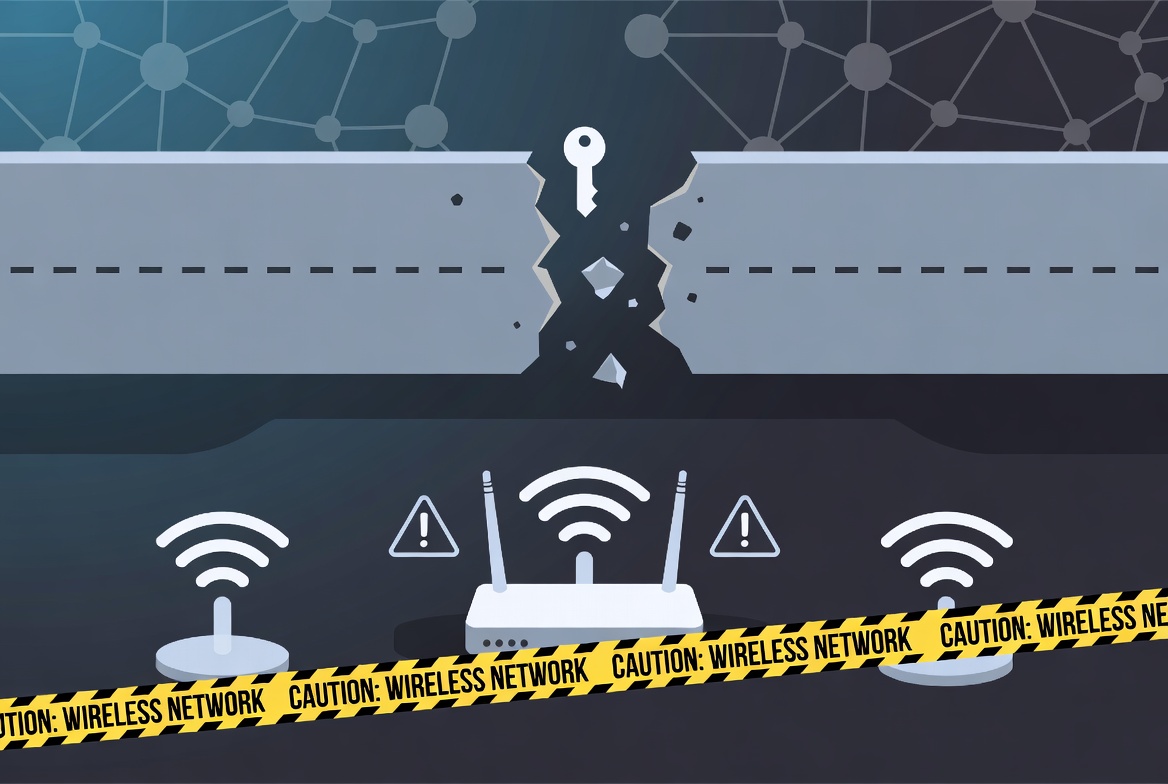
You Have No Perimeter and Your Office Wi-Fi Is a Crime Scene.
Your company has seventeen employees, a shared Google Drive folder that contains what may be the only copy of the financial forecast, and a CEO who insists on accessing the admin panel from the coffee shop Wi-Fi at JFK. You have a VPN. You feel secure. You are not secure.
The term "zero trust" has suffered the fate of all useful security concepts. It has been diluted by vendors, abused by consultants, and reduced to a checkbox that sales engineers use to justify seven-figure contracts. But the underlying principle remains both simple and devastatingly effective: trust nothing, verify everything.
The Perimeter Delusion
The traditional security model assumes a castle wall. Inside the wall, you are safe. Outside the wall, you are dangerous. This model worked when employees worked in offices, when corporate data resided on corporate servers, and when the primary threat vector was a disgruntled sysadmin with a tape drive.
In 2026, your employees work from Buenos Aires, your data lives in four different SaaS platforms, and your "corporate network" is whatever Starbucks happens to be open at 2:00 PM. There is no wall. There never really was.
The Pragmatic Zero Trust Stack
1. Identity as the New Perimeter
If there is no network perimeter, the only meaningful boundary is authentication. This means every access request, regardless of origin, must be authenticated and authorized. It also means that password-based authentication is no longer acceptable.
Implement phishing-resistant multi-factor authentication. This is not the SMS-based verification that your bank still uses. This is WebAuthn, passkeys, or hardware tokens. Google reported in 2023 that passkeys are twice as fast as passwords and significantly more secure. It is 2026. If you are still using passwords as your primary authentication mechanism, you are effectively inviting attackers to guess until they succeed.
2. The Principle of Least Privilege Applied Pragmatically
Every employee should have access to exactly the resources required to perform their job function and no more. This sounds obvious. It is almost never practiced.
The marketing coordinator does not need read access to the source code repository. The sales director does not need write access to the production database. These are not controversial statements, yet the default configuration of most SaaS platforms is "everyone can see everything until someone complains."
Conduct an access audit. Use a tool like Accessly or StrongDM to visualize who has access to what. You will be horrified. This is normal. Reduce access systematically, starting with the most sensitive systems.
3. Device Trust Without MDM Overkill
The ideal zero trust environment inspects every device for compliance before granting access. The reality for most SMBs is that Mobile Device Management solutions are expensive, intrusive, and require a level of IT sophistication that simply does not exist.
Cloudflare Zero Trust offers a pragmatic middle ground. It can perform device posture checks—operating system version, disk encryption status, active firewall—without requiring full MDM enrollment. If the device is not compliant, access is blocked or limited. This is not perfect security. It is dramatically better than nothing.
4. Microsegmentation for Normal People
Microsegmentation, the practice of dividing your network into isolated zones, sounds like an enterprise-scale undertaking. It does not have to be.
If your applications are primarily SaaS-based, your network is already segmented by virtue of being the public internet. The risk is not lateral movement between servers in your data center. The risk is credential stuffing against your Google Workspace account.
The solution is conditional access policies. Require trusted locations for administrative functions. Block access from countries where you have no business operations. Require re-authentication for sensitive actions. These are configuration changes, not architecture projects.
The Implementation Timeline
Week 1: Enable phishing-resistant MFA for all administrative accounts. This includes your domain registrar, your cloud provider console, and your identity provider.
Week 2: Audit third-party OAuth grants. Revoke access for applications that are no longer in use. This is the digital equivalent of canceling your gym membership from 2014.
Week 3: Implement conditional access policies. Start with a simple policy: block access to internal applications from untrusted networks.
Week 4: Begin the principle of least privilege rollout. Focus on shared drives and collaborative documents. These are the highest-risk, lowest-hanging targets.
The Honest Conclusion
Zero trust is not a product you purchase. It is a configuration you implement. The enterprise vendors have convinced the market that security requires a six-figure annual commitment and a dedicated security architect. This is false.
You can achieve meaningful zero trust improvements with the tools you already own or with free-tier services from Cloudflare, Google, and Microsoft. The barrier is not technical. It is the belief that security is something you buy rather than something you do.
Your CEO will continue to use airport Wi-Fi. That is inevitable. What is not inevitable is that the airport Wi-Fi user can access the entire corporate data estate without additional verification. That is a choice. Make a different one.
Comments (0)